
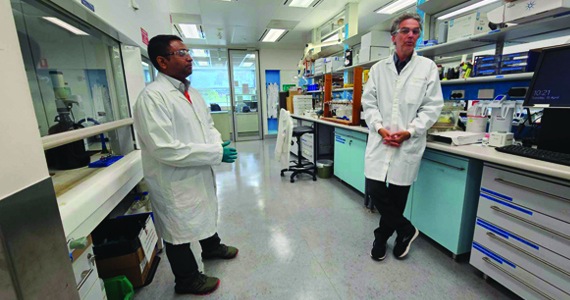
ChemCentre was proud to welcome Dr Vincent Lal from the Institute of Applied Science Environment Unit at the University of the South Pacific (USP), Fiji, for a specialised training program designed to strengthen oil spill response capabilities across the Pacific region.
Dr Lal’s visit, held last month at ChemCentre’s headquarters in Perth, was supported by the Secretariat of the Pacific Regional Environment Programme (SPREP)—an intergovernmental organisation dedicated to environmental protection and sustainable development across the Pacific.
His time at ChemCentre formed part of a broader regional initiative to build capacity in environmental forensics, particularly in the advanced fingerprinting of petroleum hydrocarbons to trace the source of marine oil pollution.
At the heart of this work is a technique often referred to as oil “fingerprinting.” While metaphorical, the term describes how scientists identify a unique chemical profile made up of trace compounds, such as hopanes and steranes, found in crude and refined oils.
These profiles vary between oil sources, allowing scientists to distinguish one sample from another, much like a human fingerprint. Although over 140 such compounds may be present, ChemCentre’s methods are capable of isolating and analysing these signatures with precision.
Over an intensive 3.5-day program, Dr Lal undertook hands-on training in oil spill fingerprinting techniques with Leif Cooper, Senior Chemist and Research Officer in Organic Chemistry at ChemCentre. With a focus on building scientific capabilities across the Pacific, strengthening environmental resilience.
“The training focused on sophisticated laboratory methods used to analyse and identify the chemical composition of oil residues.” Said Leif.
“This is critical for understanding the origin of petroleum hydrocarbons and supporting effective environmental response efforts.”
Dr Lal has returned to USP’s laboratory in Suva, where he will now implement the techniques learned during his time at ChemCentre. His work will also include training additional team members, further supporting long-term capability development in Fiji and the broader region.
ChemCentre is proud to contribute to scientific exchange efforts that help protect marine environments and promote sustainable practices throughout the Pacific.
We look forward to seeing the lasting impact of Dr Lal’s work and to continuing our partnerships with USP, SPREP, and the wider Pacific scientific community.